

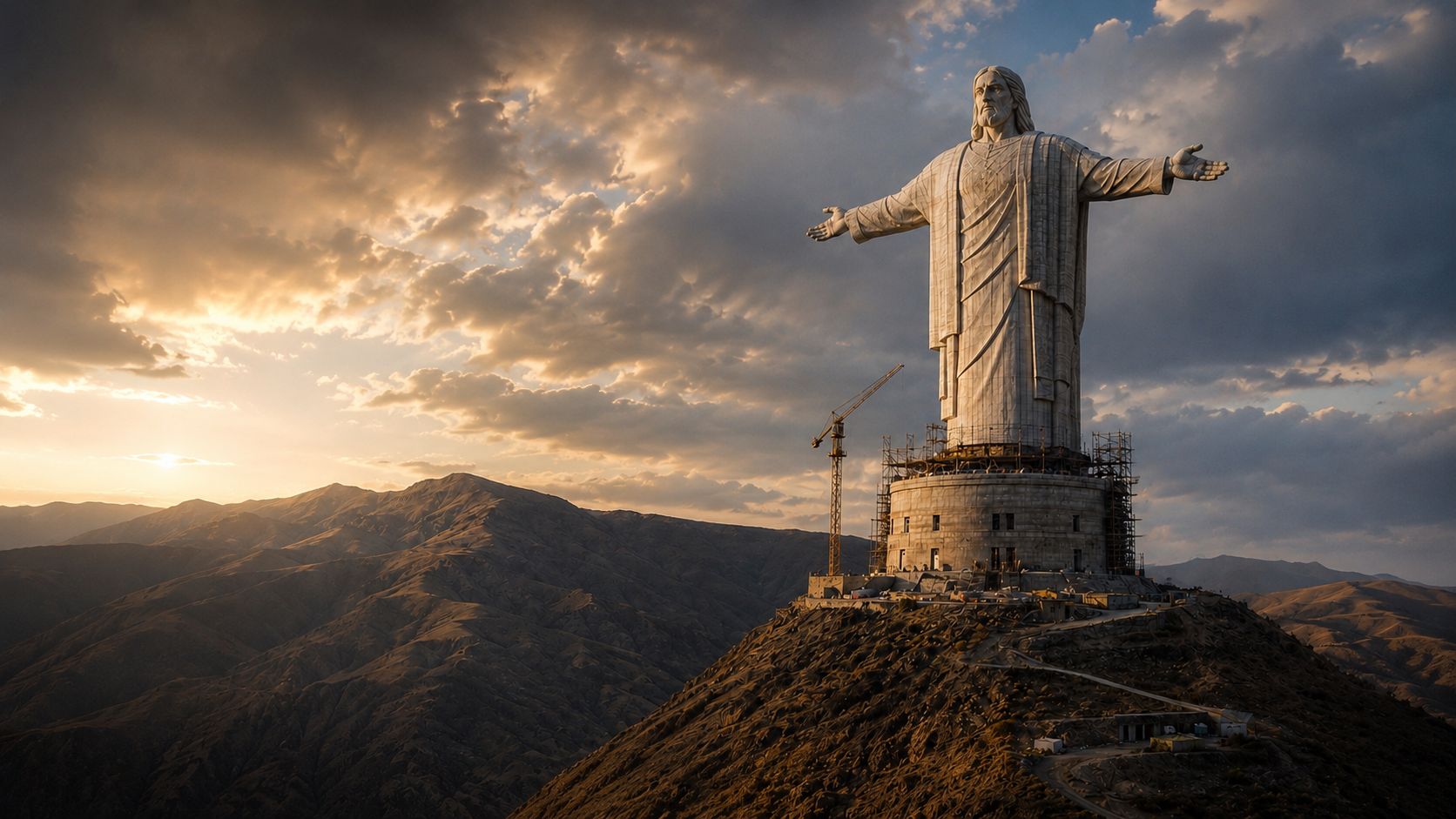
Armenia is moving ahead with a vast Jesus Christ monument on Mount Hatis, near Yerevan, in a project that supporters describe as a national symbol of faith and revival, and critics see as a controversial intervention in a culturally and environmentally sensitive landscape.
The monument is backed by Armenian businessman and former politician Gagik Tsarukyan, who first announced the project in 2022. It is being built on Mount Hatis, a volcanic peak around 30 kilometres northeast of Yerevan, after years of delays, legal questions, church opposition, and concern over damage to archaeological remains. RFE/RL reported in March 2026 that construction work had resumed on the pedestal, with a project spokesperson giving a tentative completion date of 2027.
At the centre of the debate is a simple question: when does a religious monument become a powerful expression of identity, and when does it become excessive?
What Is Being Built?
The project is designed as a monumental statue of Jesus Christ placed on a large pedestal on Mount Hatis. Many reports have described the structure as a 33-metre statue placed on a 44-metre pedestal, giving a total height of 77 metres. Eurasianet reported those dimensions when the project was first halted in 2022, and JAMnews also reported the same figures, noting that the 33-metre height of the Christ figure was intended to symbolise the age of Jesus.
There is some variation in recent reporting about the final height. RFE/RL reported in 2026 that the statue and pedestal are planned to rise 101 metres in total, while also comparing the project with Brazil's Christ the Redeemer and New York's Statue of Liberty. Because of these differing figures, the safest description is that the monument is planned to be among the world's largest Jesus statues if completed as proposed.
The statue itself has reportedly been constructed in sections in Zovuni, near Yerevan, before eventual installation at the mountain site. RFE/RL reported that the aluminium statue is currently awaiting transport to the pedestal location, where construction has resumed after earlier delays.
Why Mount Hatis?
Mount Hatis is not just a dramatic backdrop. Its height, visibility, and proximity to Yerevan make it symbolically powerful. Supporters of the project argue that the monument could become a new religious and tourism landmark, drawing visitors to Armenia and placing the country's Christian heritage on a global stage.
That symbolism matters. Armenia is widely recognised as the first state to adopt Christianity as a state religion, traditionally dated to 301 AD. The country's Christian identity remains central to its national story, and supporters of the statue have framed the project as a statement of spiritual endurance and cultural pride.
Tsarukyan has presented the monument as a sign of revival, especially in the aftermath of Armenia's traumatic conflict with Azerbaijan over Nagorno-Karabakh. RFE/RL reported that he said the statue would "show the path to revival and light to the Armenian people."
That is the emotional power behind the project. It is not only about height. It is about visibility, memory, and national morale.
Why Is It Controversial?
The controversy begins with religion itself. The Armenian Apostolic Church has opposed the project, arguing that statues of Christ are not part of Armenian religious tradition. RFE/RL reported that church authorities said they did "not consider the installation of a statue of Our Lord Jesus Christ acceptable," while Christian Post also reported that the church reaffirmed its opposition.
This is important because the debate is not simply religious versus secular. Some of the strongest objections have come from within Armenia's own Christian tradition. In Armenian sacred art, public expressions of Christianity are more commonly associated with carved khachkars, or cross-stones, rather than giant figurative statues of Christ.
The second concern is heritage. The project was delayed after a 2022 groundbreaking ceremony on Mount Hatis reportedly damaged parts of an ancient fortress. Armenia's culture authorities later said the project could not continue at the original summit location, and the pedestal site was moved several hundred metres away to a lower part of the mountain.
The third concern is environmental. Mount Hatis has been identified as a geological natural monument, and Armenian media have reported concerns about construction near specially protected areas. Zartonk Media, citing Armenia's Ministry of Environment, reported that the project must comply with laws covering specially protected natural areas, including construction safety, water use, and environmental standards.
The fourth concern is social priority. Critics argue that a costly symbolic project raises uncomfortable questions in a country facing economic, security, and infrastructure pressures. The project is privately funded, but the debate still touches a public nerve: even private monuments can reshape public land, national image, and cultural priorities.
The Tourism Argument
Supporters of the monument believe it could become a major attraction. Religious tourism is powerful because it combines pilgrimage, national branding, and emotional experience. If completed, the Mount Hatis statue could become an instantly recognisable visual symbol for Armenia, much as Christ the Redeemer is for Rio de Janeiro.
RFE/RL reported that even before completion, sections of the statue in Zovuni were already attracting foreign visitors, with at least one Yerevan-based guide adding the site to tour itineraries.
That is the strongest practical argument for the project. A landmark of this scale can generate attention, tourism, and economic activity. For a small country with a deep Christian history, the statue may be seen as a way to turn heritage into global visibility.
But tourism value alone does not settle the argument. Monuments can attract visitors while still raising legitimate questions about taste, tradition, land use, and cultural authority.
Analysis: A Monument Bigger Than Its Measurements
The statue's height has made it viral, but the real story is not only architectural. It is political, cultural, and spiritual.
For supporters, the monument offers a form of national reassurance. Armenia has endured war, displacement, political instability, and uncertainty over its future. In that context, a vast Christ figure overlooking the landscape can be read as a symbol of protection and continuity.
For critics, the same image can feel like spectacle: a private billionaire's legacy project placed onto a mountain with archaeological and environmental significance, despite opposition from the country's historic church.
Both interpretations matter. That is why the project is so compelling. It sits at the intersection of faith and branding, grief and ambition, devotion and controversy.
The strongest defence of the statue is emotional. It gives people a symbol at a time when symbols matter. The strongest criticism is institutional. Armenia already has a deep Christian tradition, and critics argue that this tradition does not need to be amplified through a giant imported style of religious monument.
In other words, the question is not whether Armenia has a Christian identity. It clearly does. The question is who gets to define how that identity should be represented in the modern world.
What Happens Next?
The project appears to be advancing again after years of delays, with the pedestal under construction and a tentative completion timeline reported for 2027. However, the controversy is unlikely to disappear. Questions over permits, heritage protection, environmental safeguards, church opposition, and public sentiment will continue to shape how the monument is received.
If completed, the statue may become one of Armenia's most recognisable landmarks. Whether it becomes a beloved symbol or a lasting point of division will depend on more than its size. It will depend on whether Armenians come to see it as an expression of shared identity, or as a monument imposed on a landscape already rich with older, quieter forms of faith.
For now, Mount Hatis has become the stage for a larger national debate: not just about what Armenia builds, but about what it chooses to remember, protect, and project to the world.
Spot an error? contact@theobsidian.media